







Why your heat pump won't turn on in New Mexico

Step 1 of 3: Equipment

A heat pump that won't turn on is usually stuck on power or on its controls, not on the refrigerant side. Check the breaker first. Heat pumps draw on a dedicated circuit, and a tripped breaker or a blown fuse at the outdoor unit will shut the whole system down with no warning at all. Next check the thermostat. If the display is blank or frozen, the thermostat itself may have lost power even though the rest of the house hasn't. A bad run capacitor is another common cause: it can leave the outdoor fan silent while the indoor blower still runs, which is an easy thing to notice if you listen for it. Since most homes in New Mexico heat with gas, a dead heat pump in winter is less urgent than it would be if it were your only heat source, but in summer it's your only cooling, and a system that won't start on a hot, dry day is worth having looked at before it turns into a bigger repair.

A woman in a cream cowl-neck sweater sits by a window with snow outside, in a dimly lit living room with a sofa, lit lamp, mirror, candles and a fireplace.
A woman in a gray turtleneck sweater sits beside a large window looking out at snow-covered evergreen trees, in a dimly lit living room with a lit fireplace, lamps, couch and houseplant.
A woman in a cream turtleneck sweater stands beside a large window with snow-covered ground and bare trees outside, in a dimly lit living room with lamps, a sofa and framed art.
A woman in a grey cowl-neck sweater stands indoors near a window, looking out at falling snow, with a lamp, framed picture and couch in the warmly lit room behind her.
A gray outdoor condenser unit on a concrete pad beside a light green lap-sided house, with a wall-mounted electrical disconnect box, mulch bed with shrubs, river rock, and a paved walkway in the foreground.
The outdoor unit sits clear, coils open to the air, running the way it should on a dry New Mexico afternoon.
An outdoor air conditioner condenser unit on a concrete pad beside a house with horizontal lap siding, with refrigerant lines entering the wall and a shrub on bare soil to the left.
Coils caked with dust and yard debris choke airflow, a common problem after a dry, dusty stretch with no rain to rinse them.

Setting the thermostat higher sends a low voltage signal down a control wire to a board on the outdoor unit. That board doesn't just start the compressor. It checks first for a safety fault, a pressure switch tripped, a temperature limit exceeded, anything that would make running unsafe. Only then does it let things move. A lot can interrupt that chain before the compressor ever turns. The reversing valve has a solenoid that switches the unit between heating and cooling, and when it fails, you might hear a hum or a half-start followed by silence. There's also a defrost control board, and if it gets stuck, the system can sit in defrost mode indefinitely, which from inside the house just looks like the heat pump doing nothing. Low refrigerant charge causes its own shutdown, tripping a pressure switch and locking the compressor out before it starts. Even something as simple as dust works against you here. A dry stretch with no rain can leave enough grit on a contactor's contacts that they stop closing when the signal tells them to.

What Happens When You Flip the Thermostat

  • The thermostat calls for heat by sending a low voltage signal through the control wire to the outdoor unit's control board.
  • That board checks for a safety fault, like a pressure switch or a high or low temperature limit, before it lets the compressor start.
  • If the reversing valve solenoid has failed, the unit may hum or try to start and then shut back off.
  • A defrost control board that's stuck can hold the system in defrost mode, which looks like the heat pump refusing to run at all.
  • Low refrigerant charge can trip a pressure switch and lock out the compressor before it ever turns on.
  • Dust and grit pulled in during a dry stretch can coat a contactor's contacts enough that they stop closing on command.
A bearded man in a blue and brown plaid flannel shirt stands indoors looking out a window at snow-covered trees, with a ceramic mug on the windowsill.
A man in a blue T-shirt sits on a light gray sofa, laughing while looking at an open laptop in the foreground, with a framed picture, lamp and potted plant behind him.

Why the breaker trips at all

A heat pump pulls more current when it starts than when it runs. Dust-caked coils or a weak capacitor make the compressor work harder to get going, and that extra draw is what trips the breaker. So a tripped breaker is sometimes the system telling you something upstream is already strained, not a wiring problem on its own. Resetting it once is fine. If it trips again within a day, something is making the unit work too hard to start, and that part needs a look before the breaker gets flipped a third time.


What the defrost cycle is doing

In winter, a heat pump's outdoor coil can frost over, and the system runs a defrost cycle to clear it, reversing briefly and running the outdoor fan differently than normal. During that cycle the unit can look like it shut off, with no outdoor fan movement and a burst of what seems like exhaust. That's normal for a few minutes. If the unit stays quiet well past that, or the coil still has ice on it afterward, the defrost control or a sensor isn't doing its job, and the system won't come back on correctly without it.

Power costs 14.85 cents per kilowatt-hour statewide

At 14.85 cents per kilowatt-hour, a heat pump that won't start isn't running up your bill, but one that short cycles or strains to come on will. Catching the problem now, before it works the compressor harder, keeps that rate from costing you more than it should.

EIA-861 2025 statewide residential average

In most New Mexico homes, gas handles the heat and the heat pump only has to carry the cooling load, so when it won't start you may not notice for days.

By the time you do notice, a dry afternoon has turned into a house with no cool air and a dusty coil that's been struggling longer than you knew.

An outdoor air conditioner condenser unit on a concrete pad beside a house with horizontal lap siding, with refrigerant lines and a gray electrical disconnect box on the wall, surrounded by bare dirt.
Before you get your heat pump repair
A gray outdoor condenser unit on a concrete pad beside a house with horizontal lap siding, connected by conduit and lines to a wall-mounted disconnect box, with a shrub and gravel bed to the left.
After you get your heat pump repair

The right pro for this job

A heat pump that won't start is rarely a one-wire fix, and by the time you've checked the breaker, the thermostat wiring, and the coil, you've spent an afternoon and you're still guessing. Most New Mexico homes lean on gas for heat, so a dead heat pump often sits unnoticed until a hot, dry stretch hits and you need the cooling it's supposed to carry. That's the point where diagnosing it yourself costs you more than time. A contractor who works on these systems can trace the fault, whether it's the breaker, the control board, or a coil choked with dust, and know which one it is instead of swapping parts to find out. Sending the request means you stop carrying that problem alone. You don't have to track down who's available or whether they know heat pumps in this climate. Someone matched to your situation reaches out to you, and the house stays off your mind while that happens.

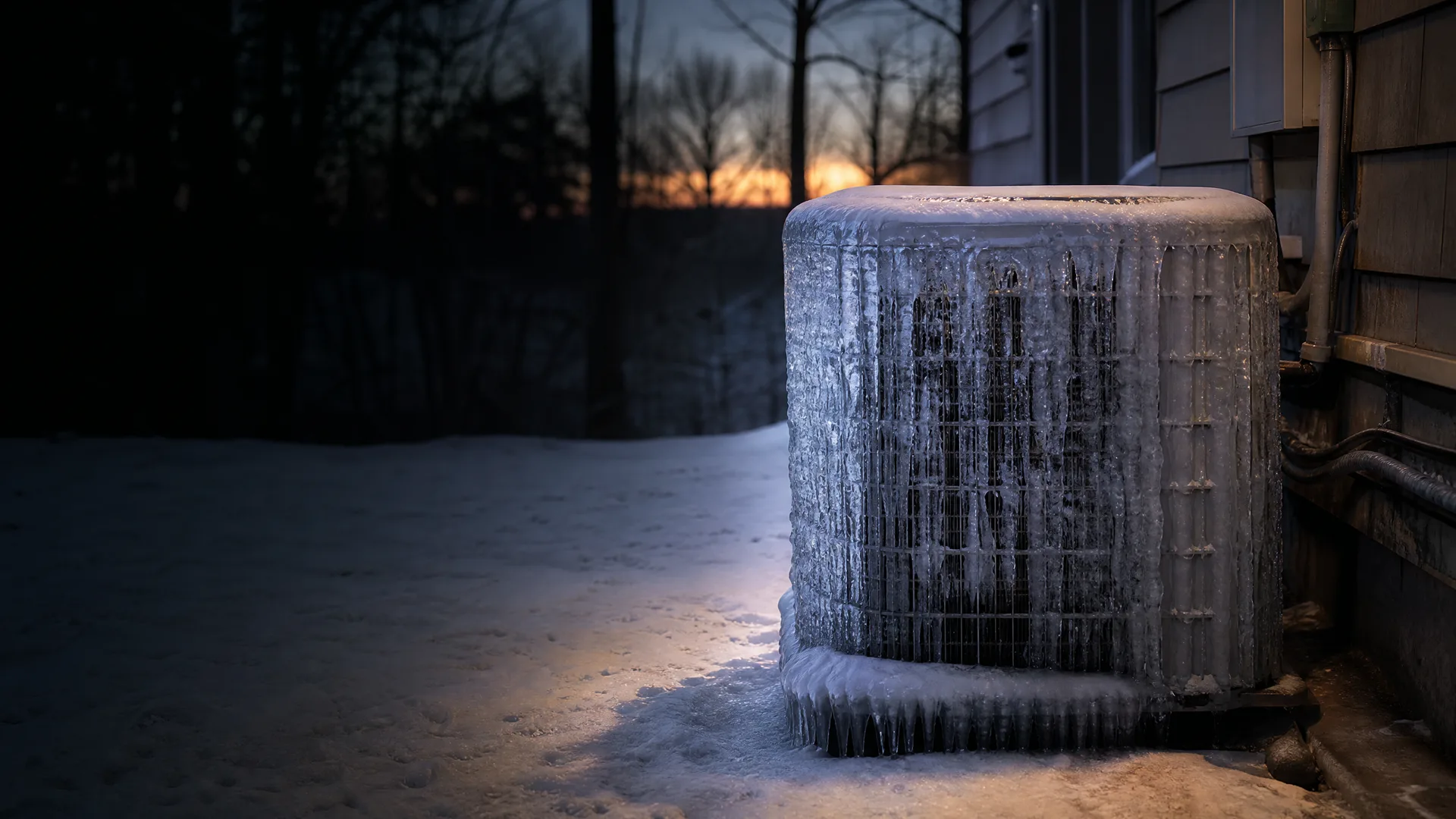
An outdoor condenser unit encased in thick ice stands on snow beside a house with horizontal siding and exterior pipes, with bare trees and a sunset glow in the background.

You go out to the side yard a little after sunrise to grab the trash cans before the wind picks up. The light is still gray and your breath shows. The heat pump sits against the wall, and this morning it's wearing a shell of ice from the base pan up over the coil, thick enough that you can't see the fins underneath. No hum, no fan turning. You crouch down and touch it and the ice doesn't give. Frost like this usually melts off on its own by midmorning once the sun hits that side of the house. This time it hasn't, and the unit is just sitting there, quiet, locked under it.

Why does my heat pump click but not start?

You flip the thermostat over to heat and the outdoor unit answers with a click, maybe two, and then nothing. No hum, no fan, no compressor. It's not silent and it's not running, and that in-between is what throws people. A click means the system is trying. Something downstream of that click is stopping it from going any further.

The click is the contactor pulling in. If the compressor doesn't follow, the capacitor usually isn't

That click is the contactor, a relay in the outdoor unit that closes to send power to the compressor and fan. It closing means the thermostat signal got through and the control board gave the go-ahead. What usually stops things right there is the start capacitor. It's supposed to give the compressor motor the jolt it needs to get moving. A capacitor that's weakened lets the contactor close but can't push the motor past that first turn, so you get the click and then quiet. Heat exposure wears capacitors down faster, and a dry New Mexico summer puts real heat on that outdoor unit even though a gas furnace is doing the winter work. A contractor can test the capacitor's rating in minutes and know if that's the part at fault.

A single-story gray horizontal-siding house with multiple front-facing gables, white-trimmed windows, a dark front door, and a concrete walkway crossing a partly dry lawn under a clear blue sky.

New Mexico air is dry, but it isn't weightless. Averaged over the summer, the dew point here runs 45°F, according to NOAA climate data, which is low next to most of the country. That dry air lets a heat pump's outdoor coil shed heat fast when it's running right. It also means less moisture gets pulled out of the air around the unit to settle as dust on the coil fins. Over a dry stretch with no rain, that dust builds up anyway, and a coil caked with it can't move the air it needs to start up and keep running.

NASA POWER T2MDEW county cells weighted by homes

What are you noticing right now at the unit

You flip the thermostat to heat or cool and walk away expecting the house to catch up. Instead, nothing changes. Maybe the outdoor unit is dead quiet, no fan, no hum. Maybe it clicked once and stopped. Maybe the indoor air handler is running but the air coming out feels no different than the room. Since most homes here lean on gas for heat, you may only notice this on a warm afternoon when the cooling side won't answer, and by then the house has had time to sit warm while you were elsewhere. If the outdoor coil has been catching yard dust with no rain to rinse it, that neglect is part of why the system is struggling to start at all.

A gray outdoor condenser unit on a concrete pad beside a light-colored lap-sided house, with a wall-mounted disconnect box, refrigerant lines, mulch bed and shrubs, and a concrete walkway in the foreground.

Running clear

Coils open on all sides, the pad underneath is clean, and the disconnect box and refrigerant lines sit undisturbed against the wall. A unit kept clear like this pulls air through easily and starts without straining, which is what you want on a dry New Mexico afternoon.

An outdoor air conditioner condenser unit with rust spots on its top grille sits on a concrete pad beside a house with light horizontal siding, with conduit lines and an electrical box on the wall and a mulch bed to the right.

Choked and worn

Rust spreads across the top grille, dirt piles up around the base, and the fan grille shows its age. A heat pump in this shape has to pull harder to move air through clogged coils, and that extra strain is often what keeps it from starting at all.

A woman in a cream sweater and jeans stands in the open doorway of a white stucco house, holding the dark door, while a man in a dark quilted jacket seen from behind walks toward the entry past potted plants.

Where that leaves your heat pump

A heat pump that won't turn on almost always traces back to power, a control signal, or airflow, not the refrigerant inside it. Checking the breaker, the thermostat wiring, and the coil tells you which one you're dealing with, but it doesn't fix it. That still takes a hand that knows the control board and can test the capacitor without guessing.

Send in the form and the search is done. A contractor who works on heat pumps in your area gets your details and reaches out, and from there it's a conversation about your unit, not a stack of tabs and forum posts. You caught the problem early, which is most of the work. The rest is one phone call away.

Interior corner with a beige sofa holding a dark green and a light cushion and a textured throw, a potted small-leaved tree beside a white-framed window, and a dark shallow bowl on a wooden coffee table in the foreground.
Interior room corner with sunlight from a window, showing peeling paint and damaged plaster on the wall above a white baseboard, a wooden cabinet with a pale bowl on top, hardwood floor and a patterned rug.
Interior corner of a room with tan walls, white profiled baseboard and window trim, a wood-plank floor in sunlight, and green foliage visible through the window.
An empty room corner with cream walls, white baseboard, two windows with deep sills showing green foliage outside, and a wood plank floor lit by sunlight.
Empty room corner with beige walls, white beadboard wainscoting, chair rail and baseboard, a window with green foliage outside, and sunlight casting leaf shadows on the wall above a wood floor.
Sunlit room corner with a multi-pane window, beige walls, white baseboard, wood floor with a woven rug, and a dark wooden cabinet holding a ceramic table lamp below a framed picture.

Matched to your heat pump job

Send the request today and stop worrying about who to call.

Find a heat pump pro

There's no charge for the request.